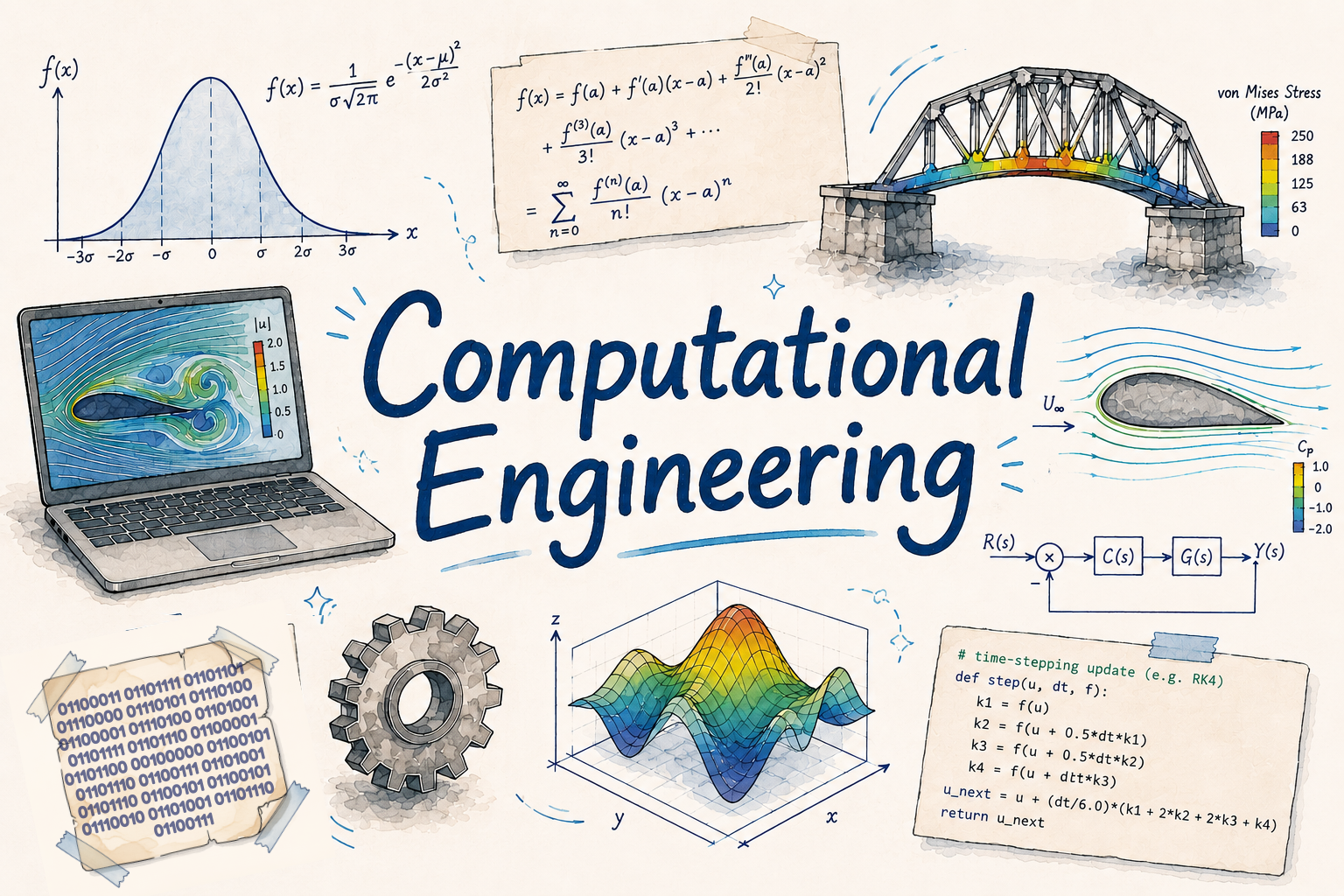
Purpose: This page is less of a blog and more of a resource hub for students looking to get ahead. Below is a collection of resources that I and other students have found helpful throughout the Computational Engineering curriculum, organized by category.
Note: If you know of a resource or learning tool that you feel was really helpful, please send me an email!
Programming & Tools
The Missing Semester of Your CS Education
Covers programming skills that are rarely taught in class but are expected in many courses, research labs, and internships (Git, the command line, shell scripting, text editors, etc.).
Git
Git is the industry standard for version control and is assumed knowledge in many courses, research labs, and internships.
Vim Resources
A handy reference if you decide to learn Vim or expect to work on remote Linux systems.
Scientific Computation
Scientific Computation
Arguably the heart of Computational Engineering. I especially recommend Chapters 16, 17, 19, 20, and 21.
Programming Languages
Python
The most widely used programming language in Computational Engineering for scientific computing, data analysis, and machine learning.
C++
Essential for high-performance scientific computing and many engineering software libraries.
MATLAB
Used heavily throughout engineering courses. MATLAB Academy also offers free interactive courses and certificates.
IDEs
An Integrated Development Environment (IDE) combines a code editor, debugger, compiler/interpreter, and project management tools into a single application.
JetBrains IDEs
Free for UT students with a registered eID. IntelliJ (Java), PyCharm (Python), and CLion (C++).
VS Code
My go-to editor. Lightweight, highly customizable, and supports virtually every programming language.
Google Colab
Run Python code directly in your browser without installing any software.
Mathematics
Calculus Resources
Calculus is the foundation of engineering. This series develops the intuition behind the concepts rather than focusing only on computations.
- 3Blue1Brown’s Calculus Series
- Calculus III (Multivariable Calculus) – Dr. Trefor Bazett
- Calculus IV (Vector Calculus) – Dr. Trefor Bazett
Linear Algebra Resources
Linear algebra appears everywhere in Computational Engineering. The resources below should help build intuition for matrices, eigenvalues, and linear transformations, and matrix factorization.
- 3Blue1Brown’s Linear Algebra Series
- The Big Six Matrix Factorizations
- MathTheBeautiful’s Linear Algebra Series
- Short Post explaining Basic Linear Algebra Concepts
Logic Theory
Proofs are the language of mathematics. Understanding logical reasoning and quantifiers (“for all” and “there exists”) will make upper-level mathematics much easier.
- How to Read Logic – Another Roof
- Discrete Math YouTube Playlist – Dr. Trefor Bazett
- Practice Problems on Logic Theory
- Great Advice on self-studying proofs
Physics
Thermodynamics
Statics
Dynamics
Mechanics of Solids
- Solids Lectures – Engineering Deciphered
- Solids Lectures – Less Boring Lectures
- An Introduction to Stress and Strain – The Efficient Engineer
Other
Control Theory
One of the most important subjects in robotics, autonomous systems, optimization, and dynamical systems.
Andrew Ng’s Machine Learning Course
One of the best machine learning courses available. A background in probability and statistics is recommended.
Steve Brunton’s Physics-Based Machine Learning Series
An excellent introduction to physics-informed neural networks (PINNs).
Optimization
A gentle introduction to optimization algorithms and why they matter in machine learning and engineering.
LaTeX Materials
A quick reference for writing mathematical documents in LaTeX.
General Computational Engineering Links
Useful links for understanding the program, planning your degree, and navigating UT Austin as a Computational Engineering student.
Finally, I’d like to thank Lasse Peters for inspiring this idea. If you’re interested in game-theoretic control and learning, I highly recommend checking out his collection of resources.